Choosing an FRP tray is not simply a corrosion decision: the resin, support span, fire evidence, cable load and installation environment all affect whether the system is suitable. By the end, you will be able to compare materials, define a technically complete purchase specification and assess supplier submittals for an industrial route.
Key takeaways
- Choose FRP for corrosion resistance, electrical insulation and lower maintenance.
- Size trays from cable diameter, fill limits, bend space and future capacity.
- Demand load tables, support spacing, fire evidence and installation instructions.
- Send every FRP cable tray supplier the same technical RFQ schedule.
What FRP cable tray is and where it fits in Maharashtra
An FRP cable tray is a cable-support system made from glass-fibre reinforcement held in a resin matrix. Pultruded trays use continuous fibres pulled through a heated die, producing strong, consistent side rails and channels; moulded trays use fibres formed in a mould, allowing different shapes and built-in features.
FRP is lightweight, electrically nonconductive and resistant to many corrosive atmospheres, but it is not an earthing path.
A sensible FRP cable tray for industrial installation fits environments such as:
- Chemical plants handling acids, alkalis or solvents, after checking resin compatibility against concentration, temperature and exposure time.
- Water-treatment and wastewater sites where moisture, salts and chemical dosing attack ordinary steel.
- Fertilizer units, coastal facilities and high-humidity areas where corrosion drives maintenance.
- Outdoor cable routes, only when the supplier provides UV-stabilised resin, gel coat or surface veil and documented weathering evidence.
| Environment | Why FRP fits | Check before ordering |
|---|---|---|
| Chemical plant | Resists site corrosion without routine coating repairs | Polyester, vinyl-ester or epoxy compatibility |
| Water or wastewater plant | Handles persistent moisture and treatment chemicals | Chemical concentration and temperature |
| Outdoor route | Low weight simplifies installation | UV exposure, fire evidence and support spacing |
| Impact-heavy area | Corrosion resistance remains useful | Choose steel or another material if impact governs |
An FRP cable tray in Maharashtra is the wrong choice where the design requires metallic bonding, severe mechanical impact resistance, or fire-performance evidence that the proposed laminate cannot provide. Supports, splice plates and fasteners need the same environmental review as the tray.
FRP versus steel, aluminium and stainless steel
Choose FRP when corrosion exposure, low weight and electrical isolation matter more than metallic stiffness, impact tolerance or inherent bonding continuity. Compare the complete system, not a tray photograph or the phrase “corrosion-proof”.
| Option | Corrosion and environment | Mechanical, electrical and cost trade-off |
|---|---|---|
| FRP | Resin choice controls resistance to acids, alkalis, solvents, salts and heat. Specify polyester, vinyl-ester or epoxy against concentration, temperature and exposure time. | Light, nonconductive and low-maintenance; verify UV stabilisation, gel coat or surface veil, weathering evidence, load, span and deflection. It does not provide the earthing path. Installed cost depends on supports and specialist fittings. |
| Hot-dip galvanized steel | Zinc coating protects steel until damage, cut edges or severe chemical exposure defeats it. | Stiff and impact-resistant, with metallic continuity when bonded correctly; heavier and more labour-intensive than FRP. Compare coating thickness and post-fabrication treatment. |
| Stainless steel | Select the grade for chlorides and process chemicals; 304 and 316 are not interchangeable in aggressive service. | Strong, fire-tolerant and electrically continuous, but heavy and expensive. Check crevice corrosion around fasteners. |
| Aluminium | Resists atmospheric corrosion but needs review near alkalis, chlorides and dissimilar metals. | Light and conductive, with lower stiffness and impact resistance than steel. Protect against galvanic contact. |
| GI perforated tray | Confirm whether “GI” means hot-dip galvanized steel and identify coating after perforation and cutting. | Economical, ventilated and easy to bond; perforations do not solve corrosion or increase load capacity. |
Ask cable tray suppliers for NEMA FG 1 evidence for FRP; NEMA VE 1 alone addresses metallic systems. For an FRP cable tray for industrial installation, request laminate identification, fastener material, UV and fire evidence, chemical data, dimensions and quality records. Choose metal when project rules demand a metallic bonding path.
Calculate tray size, fill, bends and spare capacity
Start with the cable schedule, not the tray catalogue. Record each cable’s outside diameter, quantity, weight, minimum bend radius and required separation.
- Physical fit: calculate the usable tray width and side-rail height against the cable arrangement. Include covers, gland plates, expansion joints and obstructions along the route.
- Fill: add the cable cross-sectional areas and divide by the tray’s usable area. Apply the fill limit stated by the project specification; a nominal fill percentage does not prove thermal suitability.
- Bends: check the largest cable’s minimum bend radius at every horizontal and vertical change of direction. Confirm that the selected bend radius, reducer and tee do not force a cable below that limit.
- Thermal fit: calculate ampacity after applying the actual grouping, cable spacing or touching arrangement, ambient temperature, enclosure effects and solar heating. A physically spacious tray can still overheat its cables.
- Spare capacity: reserve the project’s stated future allowance in both area and load. Do not count empty space that disappears at bends or under covers.
Ask cable tray suppliers for a scaled route layout showing straight lengths, widths, side-rail heights, bend radii, support points and cable positions.
For an FRP cable tray in Maharashtra, also compare the proposed load and deflection at the actual support span; NEMA FG 1 evidence supports the system review, but it does not replace the ampacity calculation.
Check load ratings, supports, fire evidence and installation details
A load rating without its support span is incomplete. For an FRP cable tray for industrial installation, obtain the allowable load in kg/m or kN/m at the stated span, the deflection limit and the calculation or test basis. Check that the value covers cable weight, covers, ice or water accumulation where relevant, and installation loads.
Request these submittal details before approval:
- Laminate and resin identification, tray width, side-rail height, straight length, bend radius, dimensional tolerances and joint details.
- Support drawings showing bracket, cantilever-arm or trapeze spacing, splice plates, fastener grade and tightening instructions.
- Chemical-compatibility data for the actual acids, alkalis, solvents, wastewater gases and cleaning chemicals at the site.
- UV-stabilised resin, gel coat or surface veil details and a documented weathering test for outdoor routes.
- Fire-performance evidence matching the project specification; NEMA FG 1 is the dedicated standard for fiberglass cable-tray systems. A NEMA VE 1 statement alone does not qualify an FRP tray for the same duty.
- Batch identification, inspection records and installation instructions.
Check the complete assembly, not just the tray:
| Item | Verify | Reject when |
|---|---|---|
| Load | Rated span and deflection basis | Only a maximum load is quoted |
| Environment | Tray, supports and fasteners share compatibility | Carbon-steel hardware is exposed to chemicals |
| Electrical | Protective earth and bonding design | The nonconductive tray is treated as the earth path |
| Outdoor use | UV and weathering evidence | The supplier gives only a generic corrosion claim |
For an FRP cable tray in Maharashtra, separately bond metallic covers, supports, gland plates and other exposed conductive parts.
Build a supplier RFQ that produces comparable quotations
Send every FRP cable tray supplier the same route schedule and require a line-by-line return. State tray type, width, side-rail height, straight length, bend radius, support span, design load, spare capacity, resin system, fire requirement, UV exposure and chemical environment. This prevents “all type” quotations from hiding different specifications.
Ask FRP cable tray suppliers in Maharashtra to submit:
- Laminate construction: pultruded or molded, fiberglass content, resin type, laminate identification and operating-temperature limit.
- Drawing showing dimensions, tolerances, splice locations, bend geometry, cover fit and drop-outs.
- Allowable load at each proposed support span, deflection limit and the test or calculation basis. Request NEMA FG 1 evidence; NEMA VE 1 alone does not qualify an FRP system.
- Fire-test report, UV-weathering evidence and chemical-compatibility data for the named chemical, concentration, temperature and exposure duration.
- Complete accessory schedule: bends, tees, reducers, covers, end caps, splice kits, supports, hold-downs and bonding hardware.
- Fastener grade and material, installation instructions, joint details, storage limits and replacement guidance.
- Batch number, inspection report, dimensional records and manufacturer’s quality certificate for the quoted production lot.
State separately that FRP is not the protective earthing path; require the design for protective conductors and bonding of metallic covers, supports and gland plates. TIRUMALA ENTERPRISES can be asked to quote against this identical schedule, alongside other cable tray suppliers, so price differences remain tied to documented scope.
Related products
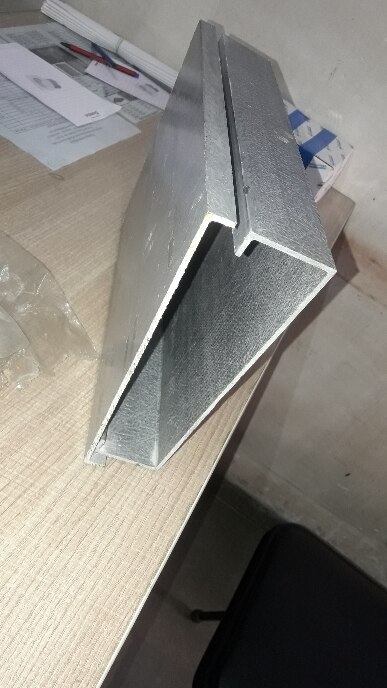 | All type FOR cable tray treading supplie View product → |
 | ₹140 View product → |
Frequently asked questions
Where does an FRP cable tray fit in Maharashtra industrial installations?
FRP cable trays suit corrosive, wet or chemically exposed areas, including water-treatment plants, chemical facilities, coastal sites and outdoor industrial routes. Select the resin and construction for the actual environment.
How does FRP compare with steel, aluminium and stainless steel cable trays?
FRP resists corrosion and provides electrical insulation, while steel offers high mechanical strength, aluminium reduces weight, and stainless steel provides strong corrosion resistance at higher material cost. Compare weight, span, fire performance, maintenance and total installed cost.
How do you calculate FRP cable tray size and spare capacity?
Add cable diameters, apply the specified fill limit, allow space at bends and entries, and reserve capacity for future cables. Check the supplier's usable internal width and depth rather than relying only on nominal tray dimensions.
What evidence should you request from an FRP cable tray supplier?
Request load-versus-span tables, support spacing, resin and fibre details, temperature limits, fire-test evidence, installation instructions, joint details and dimensional drawings. Put the same requirements into every RFQ so quotations are comparable.