A distributor needs more than a per-metre tray price: the offer must match cable type, route conditions, load, fittings, finish and replenishment requirements. By the end, you will be able to compare manufacturers, prepare a technically complete enquiry and build a project-ready stock plan for customers and electrical contractors.
Key takeaways
- Stock fast-moving widths alongside project-specific tray schedules.
- Choose ladder, tray, trunking, raceway or FRP from route conditions.
- Request thickness, finish, dimensions, accessories and packing in writing.
- Audit Nashik suppliers for repeatable quality, lead times and dispatch control.
What distributor supply must cover beyond straight tray lengths
A distributor must fulfil more than counter sales of straight tray: keep fast-moving resale stock, dispatch project-wise orders, replenish repeat customers, handle mixed-width and mixed-height schedules, and supply electrical contractors directly.
Cable tray distributor supply works only when dimensions and finishes remain consistent across batches, packing prevents transit damage, lead times and minimum order quantities are clear, and delivery covers Nashik and Maharashtra.
Ask every cable tray manufacturer for a product schedule, not merely “GI tray per metre.” Record:
- System standard, material, finish, width, side-rail height, thickness, joint type, support span and permissible working load.
- Dimensional tolerances, straightness, usable internal width, hole pattern, replacement policy and confirmation that future batches remain interchangeable.
- Lead time, minimum order quantity, packing method and delivery coverage.
Separate stocked fast-moving sizes from project-specific widths, heights and fittings. Do not promise a project from nominal tray length alone: each dispatch may also need bends, tees, crosses, reducers, couplers, splice plates, supports, threaded hardware, end caps and bonding jumpers.
A useful comparison for cable tray manufacturers for distributor applications in Nashik is whether they can reproduce the same specification, pack it safely and replace incorrect or damaged parts without disrupting the project. Include accessories in the bill of materials before quoting; a tray without compatible joints or supports cannot be installed.
A catalogue manufacturer lists products, while an operational supplier supports repeat replenishment and mixed orders.
Choosing tray, ladder, trunking, raceway or FRP for the route
Choose the route by cable duty and installation exposure, not by width alone. An open system ventilates and provides fast access; an enclosed system gives greater physical protection but retains more heat and complicates inspection.
| Option | Best fit | Main decision |
|---|---|---|
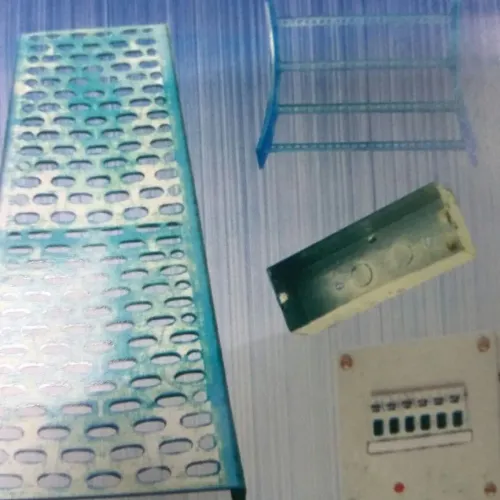
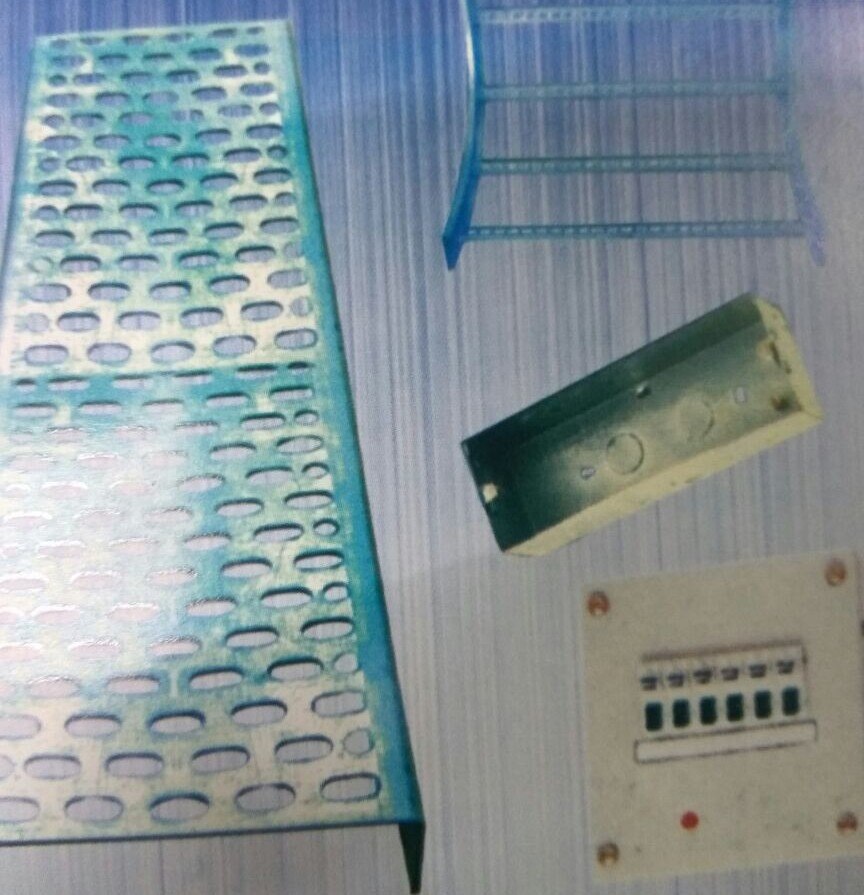
| GI perforated tray | Ventilated indoor routes carrying general power or control cables | Open base improves cooling and access; it does not provide an IP-rated enclosure |
| Ladder tray | Heavy power cables, long spans and heat dissipation | Cross-members support larger cables while leaving most of the route open |
| FRP tray | Verified corrosive environments | Check resin, chemical compatibility, UV resistance and temperature before selection |
| Enclosed GI trunking | Low-voltage control, instrumentation or wiring needing physical protection and segregation | A substantially enclosed metallic route; specify dividers or separate compartments where cable groups must remain apart |
| Aluminium raceway | Lighter indoor wiring needing a neat, corrosion-resistant, easily accessible route | Its section profile and cover arrangement distinguish it from open tray and ladder systems |
Cable tray, ladder and raceway are support or routing systems, not automatic protection against dust or water. Specify the required IP rating separately under IEC 60529; do not describe an open perforated tray as IP-rated.
Compare GI cable trunking manufacturers against IEC 61084-2-1. Assess cable tray manufacturers against IEC 61537 for mechanical performance, continuity, corrosion protection, load and deflection. Confirm tray fill, cable weight, spare capacity, ventilation, covers, dividers and support spacing as separate checks.
The technical details to include in a distributor quotation request
A quotation for cable tray distributor supply must describe a complete, load-rated system, not “GI tray per metre.” Give cable tray manufacturers enough information to price compatible lengths, fittings and supports without guessing.
1. State tray width and usable internal width, side-rail height, base and side-wall thickness, straight-length size, perforation pattern, dimensional tolerance, straightness, bend radius, cover requirement and coupler or splice-plate type.
2. Request availability of horizontal and vertical bends, tees, crosses, reducers, end caps, dividers, bonding jumpers and support hardware. Confirm that every accessory matches the quoted tray and remains available for repeat replenishment.
3. Send the outside diameter and weight of every cable; a cable count is not a capacity method. Calculate occupied width with the required fill allowance, add future spare capacity, then check the manufacturer’s loading table. Treat fill, cable weight, segregation and spare capacity as separate checks.
4. Require safe working load, tested or rated support span, deflection limit, joint position, cantilever bracket rating and trapeze-support details. Covers, bends and concentrated cable loads can change support requirements, so a wide tray is not automatically suitable for mixed power, control, instrumentation and data cables.
5. Include support spacing, installation orientation and continuity requirements. State whether dividers, separate compartments, bonding jumpers or dedicated earthing connections are required, and how continuity will be verified.
6. Ask how covers affect loading, ventilation and access, and identify any special support required at bends, joints and changes in elevation. That detail prevents a quotation that fits the route but fails during installation.
How GI and FRP specifications change the comparison
“GI” is not a complete corrosion specification. For comparable cable tray manufacturers, ask whether the tray uses continuously pre-galvanized sheet or hot-dip galvanizing after fabrication, then request the coating designation or test certificate.
Require the quotation to state base steel thickness, corrosion environment, cut-edge treatment, and whether the product is intended for indoor dry use or outdoor exposure. Cutting or welding pre-galvanized sheet exposes bare steel; post-fabrication galvanizing covers cut edges, holes and weld areas more consistently. Specify the approved repair treatment for any damaged coating.
For FRP cable tray distributor supply, request the resin system, UV resistance, fire performance, electrical insulation, operating temperature range, chemical compatibility and construction method. Identify whether each component is pultruded or moulded. Check the actual chemicals and temperature in the cable route; “FRP” alone does not prove suitability.
Include these points in the comparison:
- Request IEC 61537 evidence for mechanical performance, load and deflection, electrical continuity, and corrosion protection.
- State whether splice plates, bonding jumpers or dedicated earthing provisions are included.
- Ask how continuity will be verified across joints, especially where paint, powder coating, corrosion or loose couplers could interrupt bonding.
- Reject an offer that gives only “GI” or “FRP” without the coating, material and environmental details needed for the installation.
How to qualify a Nashik supplier for repeatable project supply
Approve a supplier only after it proves repeatability, not after it quotes the lowest metre rate. Shortlist cable tray suppliers in Nashik and request a physical sample, dimensional drawing, material and finish declaration, IEC 61537 test or rating information, and load tables showing span and deflection.
Ask each supplier for:
- IEC 61084-2-1 information for enclosed trunking, accessory drawings, packing details, and a written replacement process for transit-damaged or dimensionally incorrect parts.
- One complete bill of materials covering bends, tees, crosses, reducers, couplers, supports, threaded hardware, end caps, covers, dividers and bonding parts, not straight lengths alone.
- Confirmation of stock visibility, mixed-size order handling, repeat replenishment, project-wise dispatches, minimum quantities and delivery coverage across Nashik and Maharashtra.
Compare the evidence behind each quotation, not just the product name.
| Supplier evidence | Why it matters | Disqualifying gap |
|---|---|---|
| Sample and drawing | Confirms dimensions, hole pattern and fitting compatibility | No controlled drawing or sample |
| Finish declaration and IEC 61537 data | Tests corrosion protection, continuity, loading and deflection | “GI tray” with no finish or rating detail |
| IEC 61084-2-1 information | Separates enclosed trunking from open tray systems | Trunking offered using tray data alone |
| Packing and replacement process | Limits losses from damaged or incorrect parts | No defined replacement responsibility |
TIRUMALA ENTERPRISES can be compared with other Nashik sources when its quotation answers these questions for the required tray, trunking, FRP or raceway system. The practical test is whether the next order reproduces the same dimensions, finish and compatible fittings.
Related products
 | ₹140 View product → |
 | All type FOR cable tray treading supplie View product → |
Frequently asked questions
What must distributor supply cover beyond straight cable tray lengths?
Plan stock and dispatch for mixed widths and heights, bends, tees, crosses, reducers, couplers, covers, support hardware, earthing jumpers and project-wise packing.
How do you choose between tray, ladder, trunking, raceway and FRP?
Match the route to cable type, ventilation needs, impact exposure, indoor or outdoor conditions, corrosion risk, fire requirements and the space available for installation.
What technical details should a distributor include in a quotation request?
State tray or enclosure type, width, height, length, sheet thickness, perforation, material, surface finish, cover requirement, accessory schedule, quantity, packing and delivery location.
How can you qualify a Nashik supplier for repeatable project supply?
Check dimensional consistency, GI or FRP specifications, accessory availability, quotation clarity, batch traceability, packing, dispatch performance and the supplier’s ability to repeat approved specifications.
Related products
 | GI Perforated Cable Tray View product → |
 | Reliance type tray manufactur we are View product → |
 | ₹1800 Ms powder cotted box View product → |